
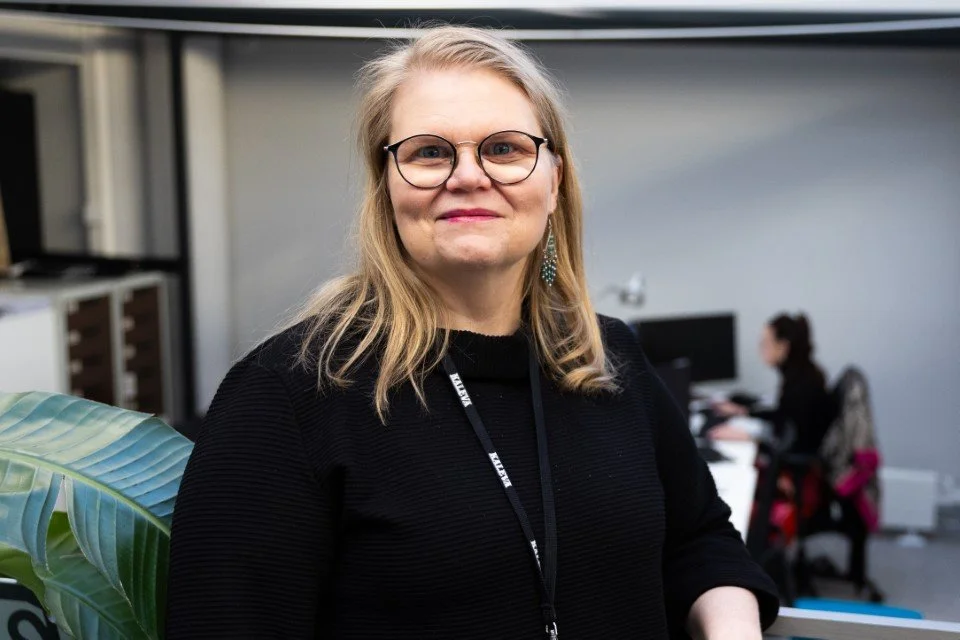
I have worked as a journalist for three decades. Over the years, I have written thousands of news articles, reports, and personal interviews for both radio and newspapers. Throughout all these years, one question has remained the same: How often do we interview women compared to men? How are women represented in the news media, and what roles do they have?
According to the international Global Media Monitoring Project (GMMP)* study, the proportion of women represented in Finnish news media has remained stagnant. Women still account for only about one-third. Over the decades, this figure has increased slowly, even though society around us has become more equal.
The same study shows that women are particularly represented as people sharing their personal experiences and in news stories covering family, care, health, and education. Men's voices, on the other hand, dominate when the discussion turns to power, societal decision-making, and the economy.
The results reflect society more broadly. In Finland, the labour market remains gender-segregated, household and caregiving responsibilities fall more heavily on women, and men still advance into leadership positions more often than women. And it is not only about gender, but also about age.
In the news media, youth is an advantage: the younger a woman is, the more likely she is to have her voice heard as an ordinary citizen or someone sharing her personal experience of a particular issue. However, a dramatic change happens almost overnight. When a woman turns 50, she practically disappears from the media. The proportion of women over 50 in the news media is a mere 16 percent. That is an incredibly low and thought-provoking figure.
Women in their 50s are at the peak of their careers. They have decades of professional experience behind them, extensive knowledge, strong expertise in their fields, and the perspective needed to understand issues affecting both their industries and the world around them. Yet they become invisible in the public eye at precisely the moment when they have the most to contribute.
It is interesting to ask what happens overnight and why women in their 50s disappear from the news, especially since no similar change occurs among men. What causes these gender differences in media representation? There are certainly several reasons, and newsrooms themselves also have reason to take a closer look at their own practices.
News reporting is often done under time pressure, which means that journalists tend to interview people they know will quickly answer their calls. When deadlines are tight, it is all too easy to call someone who can communicate their message quickly and concisely. Another reason is that women decline interview requests more often than men. This is something I have frequently encountered throughout my own career.
A highly educated woman with an extensive academic background may carefully consider whether she truly knows enough about a subject to comment on it. I must admit that situations like these frustrate me. Women have no reason to underestimate their own expertise and, as a result, exclude themselves from public discussion.
The news media is a place where expertise and the ability to communicate your message clearly and understandably are what matter. Expertise, in turn, brings influence and credibility, both of which are worth embracing.
At Kaleva, we want to do our part to ensure that women's voices and issues affecting women receive greater visibility. That is why we organise discussion events and produce a podcast called Kokonaista puhetta. We want to challenge outdated attitudes by highlighting issues that affect women's lives. We encourage women to participate actively and equally in public debate.
The next time your phone rings and a journalist calls you, say yes. You have knowledge and something valuable to say that deserves to be heard and shared.
The international GMMP study is conducted every five years, with a sample covering one day's news across newspapers and news channels in different countries. News media include regional newspapers, tabloids, Yle (the Finnish Broadcasting Company), and other digital news websites.
Minna Akimo,
Reporter